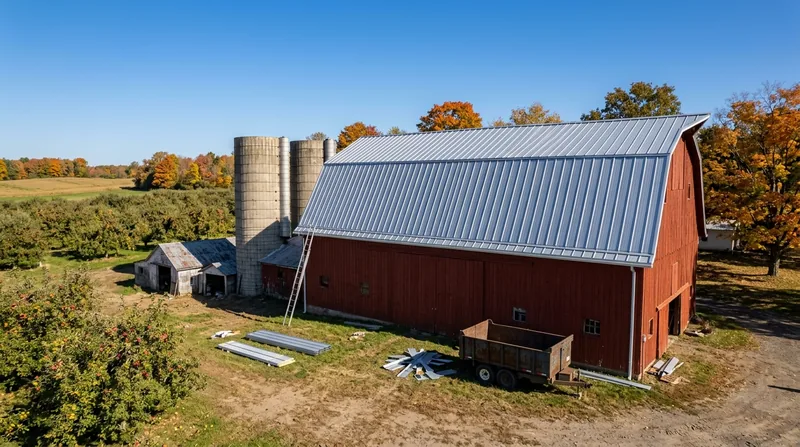




Commercial & Agricultural Metal Roofing in Buffalo: Built for Barns, Warehouses, and Old Mill Buildings
When you need Commercial & Agricultural Metal Roofing in Buffalo, you are dealing with buildings that carry real loads and real consequences: dairy barns across the Southtowns, warehouses in the old industrial corridors, churches in Black Rock and Kaisertown, and shops along the Niagara County line. Buffalo sits at the eastern end of Lake Erie where the Niagara River begins, between the Onondaga and Niagara escarpments, and the lake-effect snow that funnels off the water does not care whether the roof is over a house or a 60-foot barn. We have been installing, repairing, and replacing metal roofing here since 2009, and we build every commercial and agricultural roof for the snow load, the freeze-thaw cycling, and the wind that comes with this geography.
This is not residential work with a bigger invoice. Commercial and agricultural roofs run long panel spans, deal with condensation over livestock and equipment, and need fasteners and flashings that survive 30 years of Buffalo winters. If you want the full scope of what we do across building types, start with our metal roof installation page and then come back here for the commercial and agricultural specifics.
Why Commercial & Agricultural Metal Roofing Matters So Much in Western New York
The dominant failure mode on commercial and agricultural metal roofs in Buffalo is not sun damage. It is water and ice working at fasteners, laps, and penetrations through repeated freeze-thaw cycles, combined with heavy snow loads that sit on low-slope barn roofs for weeks. Snowvember 2014 and the December 2022 blizzard both showed what happens when a roof was already compromised before the storm hit. On top of that, the old building stock in Buffalo's industrial neighborhoods and the working farms in the Southtowns and Niagara County were often roofed with exposed-fastener panels that are now 25 to 40 years old.
- We inspect and replace failed fasteners and washers before they become leak points under snow load.
- We correct condensation and ventilation problems that rot purlins and damage stored equipment or livestock bedding.
- We install snow guards and ice protection on steep agricultural roofs where sliding snow endangers doors, gutters, and people below.
- We repair flashing and penetration details around chimneys, vents, and skylights on warehouses and churches.
- We replace corroded or dented panels with profiles matched to the existing structure and load path.
Every one of these items is cheaper to address as maintenance than as a structural repair after a February ice dam opens a seam over a barn full of cattle.
Key info: A dairy barn outside East Aurora and a warehouse off the Buffalo River do not fail the same way. Barn roofs collect condensation from livestock and need ventilation detailing. Warehouse roofs collect snow against parapet walls and need snow guards and reinforced edge metal. We scope each building on its own terms.
For the official code basis behind roof snow loads in this region, the New York State Uniform Fire Prevention and Building Code and your local building department are the governing references. Always confirm current requirements with the authority having jurisdiction before work starts. You can review New York State's building standards through the Division of Building Standards and Codes.
How We Approach a Commercial or Agricultural Metal Roof in Buffalo
We start on the ground and on the roof, not at a desk. A commercial or agricultural job in Buffalo has to account for the actual structure underneath: purlin spacing, deck condition, insulation, and how the building is used. A church in Allentown with historic district design review is a different scope from a pole barn in Clarence with a 4/12 pitch and no attic. Our process is built to catch those differences before we order a single panel.
- We walk the building with you and document the existing roof system, deck, and any active leaks.
- We measure panel runs, penetration locations, and snow load exposure against local code requirements.
- We recommend a panel profile and gauge based on span, pitch, and how the building is used.
- We provide a written scope that separates repair items from replacement items so you can prioritize.
- We pull the required permits through the local building department and schedule around your operation.
- We install, then walk the roof with you at completion and leave a fastener and flashing record.
That last step matters on agricultural buildings because the next owner or the next insurance inspection will want to know what was done and when.
Local example: A family dairy operation near Hamburg had a 1970s ribbed panel roof with leaking screw holes over the milking parlor. We replaced the fasteners and washers on the sound panels, replaced the corroded run over the parlor, and added ventilation detailing to control condensation. The herd stayed in the barn the whole time. If your building is in the Southtowns or Niagara County, our West Seneca service area page covers the surrounding agricultural corridor.
Panel Systems and Approaches We Use on Buffalo Commercial and Agricultural Roofs
There is no single right panel for every building. A standing seam roof makes sense on a church or a commercial building where appearance and long panel runs matter. An exposed-fastener ribbed panel is often the practical choice for a barn or a shop where cost per square foot and easy repair access drive the decision. We match the system to the structure, the pitch, and the budget.
| Approach | Description | Best for |
|---|---|---|
| Standing seam panel system | Concealed fasteners, raised seams, long panel runs with fewer penetrations and better snow shedding. | Churches, commercial buildings, and steep agricultural roofs where appearance and longevity matter. |
| Exposed-fastener ribbed panels | Screw-down corrugated or ribbed steel with washers, economical and easy to repair panel by panel. | Dairy barns, shops, pole buildings, and warehouses where cost per square foot drives the choice. |
| Retrofit over existing roof | New metal panels installed over a prepared existing roof, subject to code limits on existing layers. | Commercial buildings where tear-off disruption and disposal costs need to be minimized. |
| Repair and re-fastening | Replacing failed screws and washers, sealing laps, and correcting flashings on a sound existing roof. | Older barns and warehouses where the panels are sound but the fasteners and details have failed. |
| Coating and restoration | Surface prep and coating to extend the life of a structurally sound metal roof. | Commercial roofs with cosmetic fading or surface rust but no structural panel failure. |
We will tell you when a repair and re-fastening job will get you another decade and when a full replacement is the better money. We do not sell a new roof to a building that does not need one.
Commercial & Agricultural Metal Roofing Cost in Buffalo: What to Expect
Every commercial and agricultural metal roofing project in Buffalo starts with a free on-site estimate. That is the honest starting point, because the number depends on things we cannot see from a photo: purlin condition, decking, insulation, panel gauge, pitch, and how many penetrations the roof has to work around. A 40-foot barn roof with a simple gable and no skylights prices very differently from a warehouse with parapet walls, rooftop units, and 12 penetrations to flash.
The factors that move the price most are building size and roof complexity, panel system and gauge, whether we are tearing off or retrofitting over an existing roof, access for equipment and materials, and whether the building stays in operation during the work. Agricultural buildings on long rural drives in the Southtowns and Niagara County can be simpler to access than a tight commercial lot in Black Rock or Riverside. Getting two or three estimates is smart on any commercial or agricultural job, because it forces each contractor to put their scope in writing and lets you compare what is actually included.
For ballpark ranges and a breakdown by system type, see our full pricing overview. We give you a written scope, not a verbal number, and we separate repair items from replacement items so you can see where the money goes.
Commercial & Agricultural Metal Roofing Near Me: How to Vet a Contractor Near Buffalo
Finding a metal roofing contractor near Buffalo who actually works on commercial and agricultural buildings is harder than it sounds. Many residential roofers will take a barn or warehouse job and then discover on day one that they do not have the equipment, the panel supplier, or the crew for long panel runs. Ask specific questions before you sign anything, and ask them the same way you would for any other trade.
- Confirm the contractor is licensed and insured for commercial work, and ask for a certificate of insurance naming your building.
- Get two or three written estimates with the same scope so you can compare line by line.
- Ask for references on commercial or agricultural buildings of similar size and use, not just houses.
- Ask who pulls the permit and confirm the local building department's requirements for your address, since thresholds and inspections vary by jurisdiction.
- If the building is in a historic district or under HOA design review, confirm panel profile and color approval before ordering material.
A contractor who hesitates on any of those questions is telling you something. We are a Metal Roofing Alliance member and have been working in Western New York since 2009. When you are ready to talk scope, contact us for a free estimate and we will walk the building with you.
Commercial & Agricultural Metal Roofing in Buffalo: Pricing Guide
| Service | Price | Details |
|---|---|---|
| Commercial or agricultural roof inspection and written scope | Free estimate | On-site walk, panel and fastener assessment, and a written repair versus replacement breakdown. |
| Repair and re-fastening on existing metal roof | Starting at $850 | Covers failed screw and washer replacement, lap sealing, and minor flashing correction on a sound roof. |
| Exposed-fastener ribbed panel replacement | Starting at $4.50 per sq ft | Includes tear-off of existing panels, new ribbed steel, washers, and trim on a simple gable. |
| Standing seam panel system installation | Starting at $9.50 per sq ft | Concealed fasteners, raised seams, and full flashing package; pitch and panel gauge move the number. |
| Large warehouse or multi-building farm scope | On estimate | Needs an on-site look at purlins, deck, insulation, and access before any number is given. |
| Travel to Buffalo and surrounding areas | Included | No separate call-out or mileage fee across Buffalo, the Southtowns, and Niagara County. |
Indicative pricing, the exact cost depends on square footage, finish, and site access. Free personalized estimate within 24h at (716) 261-3070.


