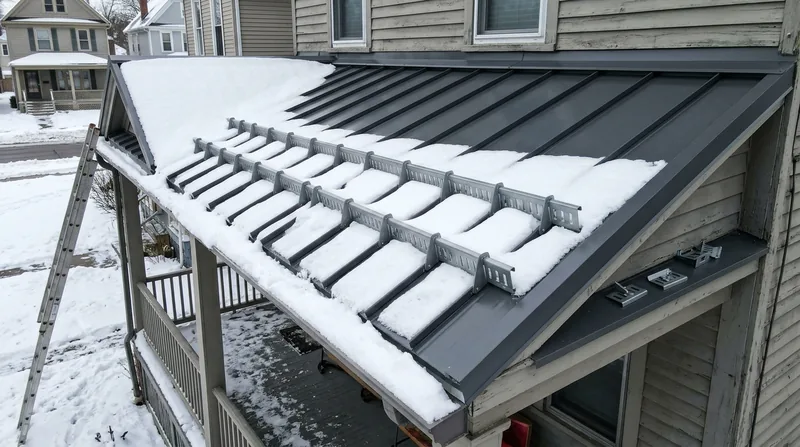




Buffalo sits at the eastern end of Lake Erie where the Niagara River begins, and the lake-effect machine above it drops snow in feet, not inches. Ask anyone who lived through Snowvember 2014 or the December 2022 blizzard what happens when a metal roof lets go. Snow Guards & Ice Protection in Buffalo is the difference between a controlled melt and a half-ton slab of ice sliding onto your steps, your car, or the sidewalk below. We install pad-style guards, bar and rail systems, and eave ice protection built for standing seam and exposed-fastener panels. Call (716) 261-3070 and we will tell you exactly what your roof needs before the first hard freeze. If your panels are already up, start with a metal roof inspection so we can map the slide zones first.
Why Snow Guards Matter More in Buffalo Than Almost Anywhere Else
Our winters run long and the freeze-thaw cycles are relentless. A metal roof sheds snow fast by design, and that is fine over an empty yard. It is not fine over the walkway to a Kenmore bungalow, the driveway of an Amherst two-story, or the back stoop of a South Buffalo double. The same lake-effect storms that bury a roof also pack that snow into a dense, heavy sheet that releases all at once when the sun hits the panels.
- Snow and ice release in sheets onto steps, driveways, sidewalks, and parked cars.
- Ice dams form at the eaves when meltwater refreezes behind the snowpack.
- Gutters and downspouts get torn off by sliding snow loads.
- Valleys and lower roof sections catch everything the main roof sheds.
- Entry doors, garage doors, and HVAC units sit right in the drop zone on most Buffalo homes.
Guards do not stop snow from accumulating. They break it up and hold it in place so it melts or releases in small, safe pieces instead of a single slab.
Key info: On a standing seam roof in Clarence or Orchard Park, a full snowpack can release with no warning on a sunny 30-degree afternoon. We size guard spacing to the roof pitch, panel profile, and the actual ground snow load for Western New York, not to a one-size-fits-all chart.
Before any work, it helps to understand how local code treats roof work. The City of Buffalo's permit office and your town's building department set the rules; start with the City of Buffalo official site for the basics, then confirm with your own municipality.
How We Install Snow Guards and Ice Protection on a Buffalo Metal Roof
We start by walking the roof and mapping where snow actually slides and where it lands. That means measuring pitch, checking panel seams and fasteners, and looking at what sits below: steps, driveways, gutters, and landscaping. On older homes in Allentown and the Delaware District, that layout is tight, so placement matters more than volume.
- We inspect the panels, seams, and fasteners so the guards attach to sound metal.
- We measure pitch and slide zones, then lay out guard rows and spacing on paper.
- We mark the mounting points and confirm the layout with you before drilling anything.
- We install pad-style guards, bar rails, or a mix, using seam clamps on standing seam and proper sealing on exposed-fastener panels.
- We add eave ice protection where heat loss and refreeze are the real problem.
- We test the layout, clean the roof, and walk you through what to expect during the first storm.
The job is done when the guards are seated, sealed, and aligned with the panel ribs, not when the last box is empty.
Key info: On a 1920s Parkside brick home with a steep front slope over the entry steps, we used seam-clamped bar rails along the eave and pad guards over the door. The homeowner had been shoveling the walk three times a day after every lake-effect band. Now the snow breaks up and stays put until it melts.
If you are planning a new roof or a retrofit, guards should go in during the same project. See how we handle standing seam metal roofing and metal roof over shingles so the snow protection is built in from day one.
Snow Guard and Ice Protection Approaches We Use
There is no single right system for every Buffalo roof. A steep Queen Anne in Allentown takes a different layout than a low-slope ranch in Cheektowaga or a dairy barn roof in the Southtowns. We match the approach to the panel type, the pitch, and what sits underneath.
| Approach | Description | Best for |
|---|---|---|
| Pad-style snow guards | Individual pads spaced in a grid pattern that hold and break up the snowpack. | Standing seam and most residential roofs. |
| Bar and rail systems | Continuous rails clamped or fastened across the roof that stop large slides. | Steep slopes and roofs over walkways or driveways. |
| Eave ice protection | Targeted treatment at the lower edge to reduce refreeze and ice dam buildup. | Homes with heat loss and chronic ice dams. |
| Hybrid layout | Rails over critical drop zones and pads across the rest of the field. | Complex roofs with doors, steps, and valleys below. |
| Exposed-fastener retrofit | Guards fastened and sealed to ribbed panels with the right washers and sealant. | Corrugated and ribbed roofs on shops and barns. |
We will tell you which system fits your roof and why, and we will not sell you more guards than the roof actually needs.
Snow Guards & Ice Protection Cost in Buffalo: What to Expect
Most residential snow guard installations in the Buffalo area start from $1,200, and that figure moves with roof size, pitch, panel type, and how many guards the layout calls for. A small porch roof over a back door is a different job than a full front slope on a two-story Amherst home with a driveway below. Access matters too: steep roofs, tight lots in Riverside and Kaisertown, and roofs with valleys or skylights take more time and more attachment points.
Bar and rail systems cost more per linear foot than pad guards, and hybrid layouts sit in between. Ice protection at the eaves adds work but solves the refreeze problem that keeps coming back. Get two or three written estimates and compare the layout, not just the total. A cheap quote that under-guards the roof leaves you right back where you started after the next lake-effect band. Our full pricing overview breaks down the moving parts.
Snow Guards & Ice Protection Near Me: How to Vet a Contractor Around Buffalo
Anybody with a ladder can screw pads to a roof. The difference shows up after the first hard winter. Ask for proof of licensing and insurance, get at least two or three estimates, and call references on jobs at least one winter old. Confirm who pulls the permit and how the contractor handles historic district or HOA design review, because panel profile and color rules apply in parts of Buffalo and its suburbs.
A contractor who has worked metal roofs across Western New York will talk about snow load, seam clamps, and eave ice before you bring it up. If the conversation stays on price per guard and nothing else, keep looking. When you are ready, contact us for a free estimate and we will walk the roof with you.
Snow Guards & Ice Protection in Buffalo: Pricing Guide
| Service | Price | Details |
|---|---|---|
| Pad-style snow guards, typical residential roof | Starting at $1,200 | Includes layout, guards, and sealing; roof size and pitch move the price. |
| Bar and rail system over walkways or driveways | Starting at $1,800 | Continuous rails clamp to seams and stop large slides; linear footage drives cost. |
| Eave ice protection add-on | Starting at $450 | Targeted treatment at the lower edge; number of eave runs and access affect the total. |
| Hybrid layout on complex or steep roofs | On estimate | Rails over drop zones plus pads across the field; needs an on-site look first. |
| Travel | Included | in Buffalo and surrounding areas, no separate call-out or mileage fee |
| Estimate | Free | Response within 24h at (716) 261-3070, no obligation to book |
Indicative pricing, the exact cost depends on square footage, finish, and site access. Free personalized estimate within 24h at (716) 261-3070.


